Did Jensen Huang Say "Liberal Arts Students Won"? You Got Fooled by the Clickbait.
 Author: Nebula Walker
Date: 31MAR2026
Mythogen Engine
Author: Nebula Walker
Date: 31MAR2026
Mythogen Engine
📌 Did Jensen Huang Say "Liberal Arts Students Won"? You Got Fooled by the Clickbait.
Recently, Jensen Huang appeared on the All-In Podcast, and his quote "English majors might be the most successful group" went viral. The media unanimously spun it with headlines like "The Liberal Arts Counterattack" and "Engineers are Going to Lose Their Jobs." The comment sections exploded, devolving into a war of words over the superiority of different college majors.
But that's not what Jensen meant at all.
First, let's restore what he actually said:
When the host asked him what young people today should study, Jensen Huang replied:
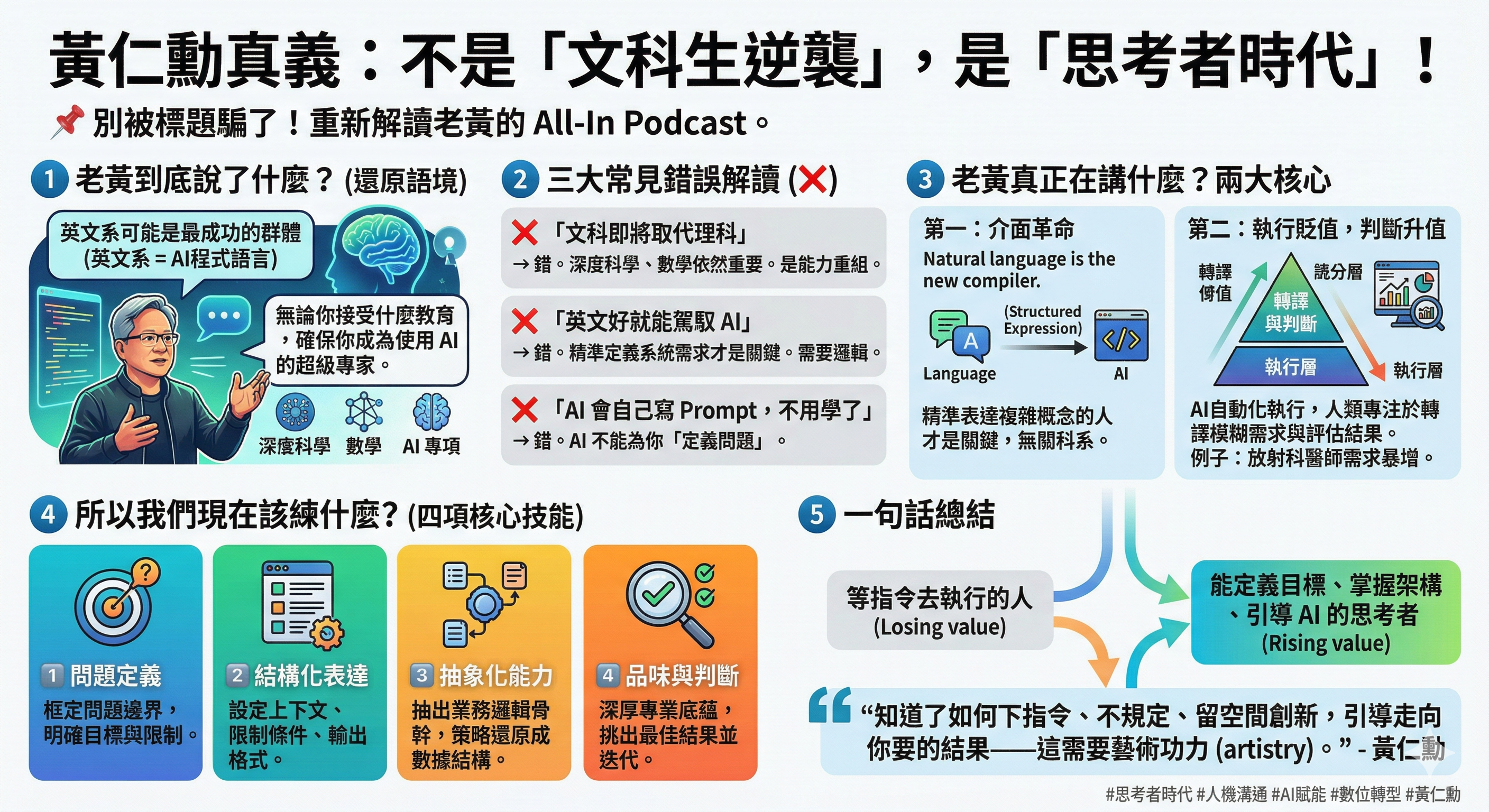
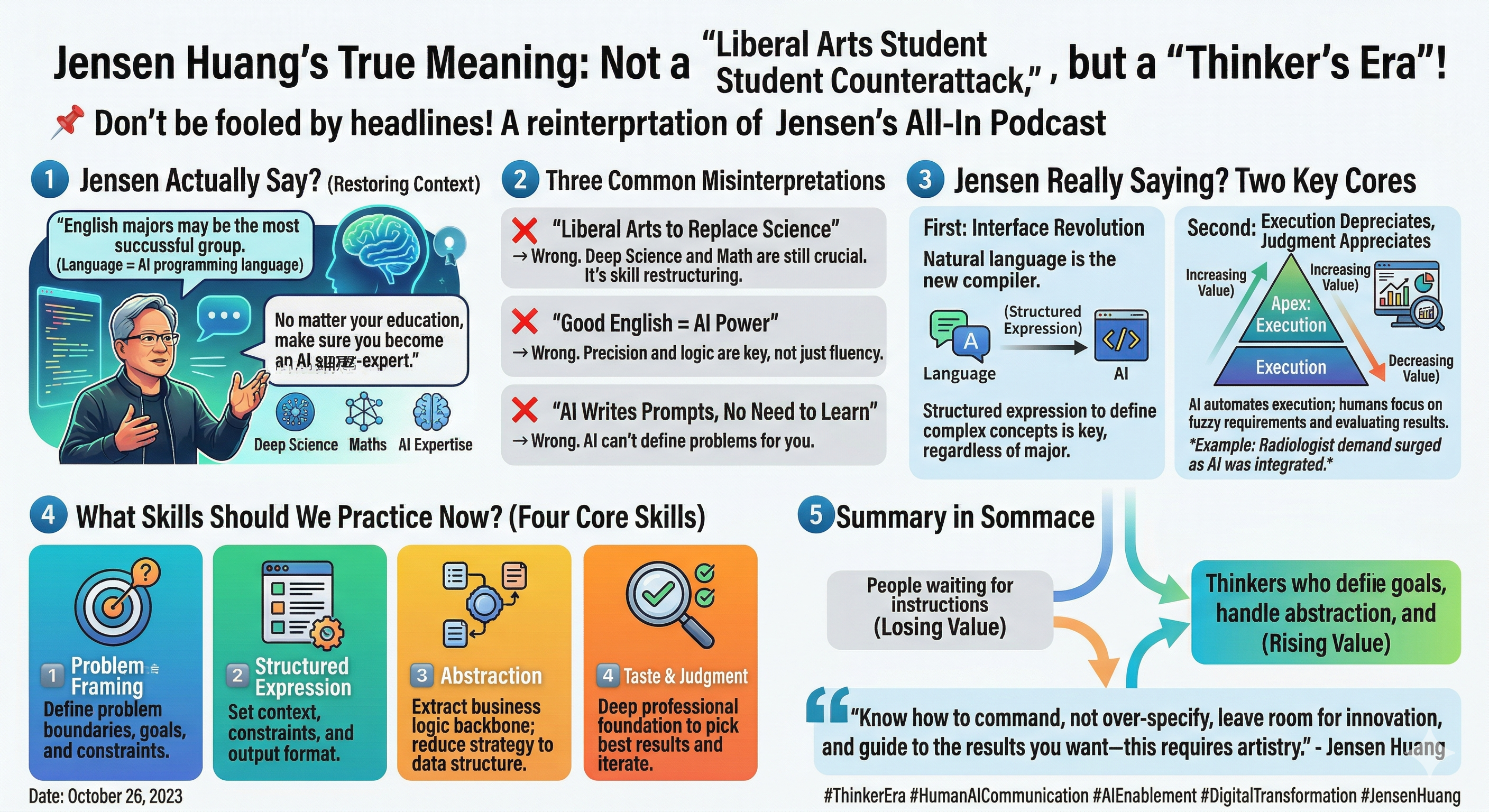
"I still believe that deep science and deep math are very important. But language skills—language is the programming language of AI, it is the ultimate program. So as a result, the English majors might be the most successful group... My recommendation is, no matter what education you receive, make sure you become a super expert at using AI."
Note: He did not say "liberal arts is better than STEM." What he was saying is—the interface for human-computer interaction has changed.
The Three Most Common Misinterpretations:
❌ "Liberal Arts Will Replace STEM" He explicitly stated, "deep science and deep math remain important." This isn't a battle of majors; it's a structural reorganization of job competencies.
❌ "Good English is Enough to Master AI" Conversational English and "precisely defining system requirements" are two completely different things. Without logic, even the most fluent English will only prompt AI to produce elegantly articulated nonsense.
❌ "AI Will Write Prompts Itself, No Need to Learn" AI can certainly help polish your prompts, but it cannot "define the problem" for you. If you can't even articulate what you're trying to solve, no matter how powerful the AI is, it can't assist you.
So what was Jensen really talking about? Two things.
First: The Interface Revolution. In the past, engineers were the sole "translators" converting human needs into code. Now, natural language itself is the compiler. When he mentioned "English majors," he wasn't glorifying liberal arts, but using it as a metaphor for those who "can precisely express complex concepts using language"—this has nothing to do with what major you study, but whether you possess structured thinking.
Second: Execution Depreciates, Judgment Appreciates. He used radiologists as an example: Ten years ago, top computer scientists predicted AI vision would eliminate radiologists. A decade later, the first half of the prophecy is 100% true—AI has indeed been integrated into every radiology platform. However, the demand for radiologists has actually skyrocketed. Because diagnostic speeds are faster, hospitals can handle more patients, and the entire market pie has expanded.
This illustrates that AI will forcefully automate the "execution layer," but it will push value upwards—towards the translation ability to "convert ambiguous needs into structured instructions," and the judgment ability to "evaluate outcomes and make decisions."
So what should we be practicing right now? Four things.
1️⃣ Problem Framing AI is the ultimate answer machine, but only if you ask the right questions. When faced with a project, don't rush to throw it at the AI—what is the core purpose of this task? Who is the target audience? What are the actual constraints? Only those who can frame the boundaries of a problem can extract valuable answers.
2️⃣ Structured Expression Don't treat AI as a wishing well; treat it as your intelligent team. You must learn to set the context, constraints, input criteria, and output format. The more systematic your instructions, the more stable the AI's output.
3️⃣ Abstraction This is the most underrated hidden skill. In enterprises, a massive amount of time is wasted on data architecture and cross-departmental cognitive alignment. AI can help you handle conversions and mapping, but the prerequisite is that you can extract the backbone from complex business logic, or reverse-engineer high-level strategies into underlying data structures. If you can't abstract it, the AI won't know how to assist you either.
4️⃣ Taste and Evaluation AI gives you ten proposals in three seconds. "Output" is no longer scarce; what's scarce is a "discerning eye." You must have profound professional depth to pick the most suitable one out of a pile of generated results and guide the AI to iterate effectively.
⚠️ But here is a structural problem that Taiwan must face.
The composite competency of "language + logic + professional judgment" that Jensen Huang described requires a cross-disciplinary knowledge foundation. But Taiwan's educational system is precisely at its most fragile on this very point.
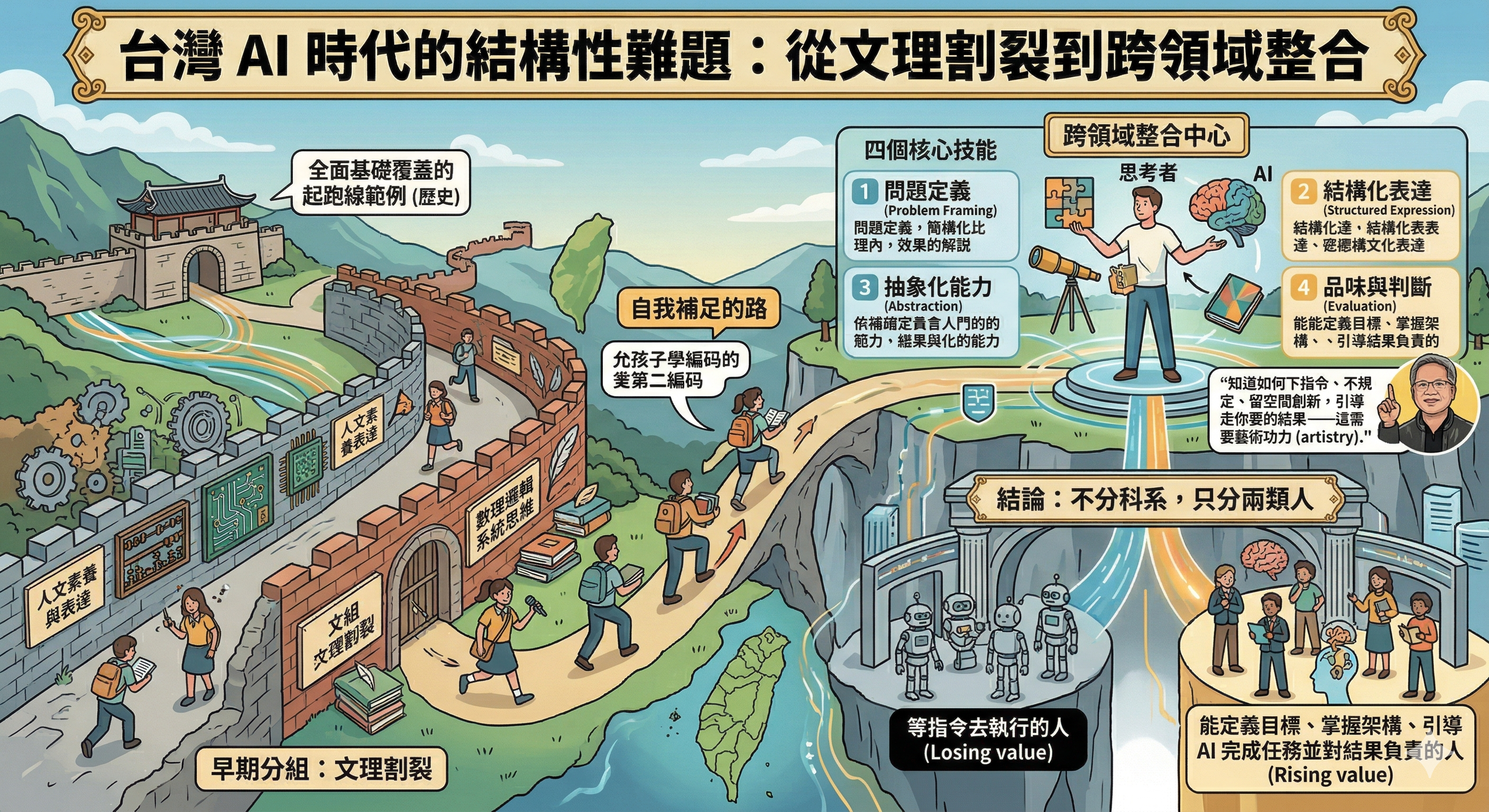
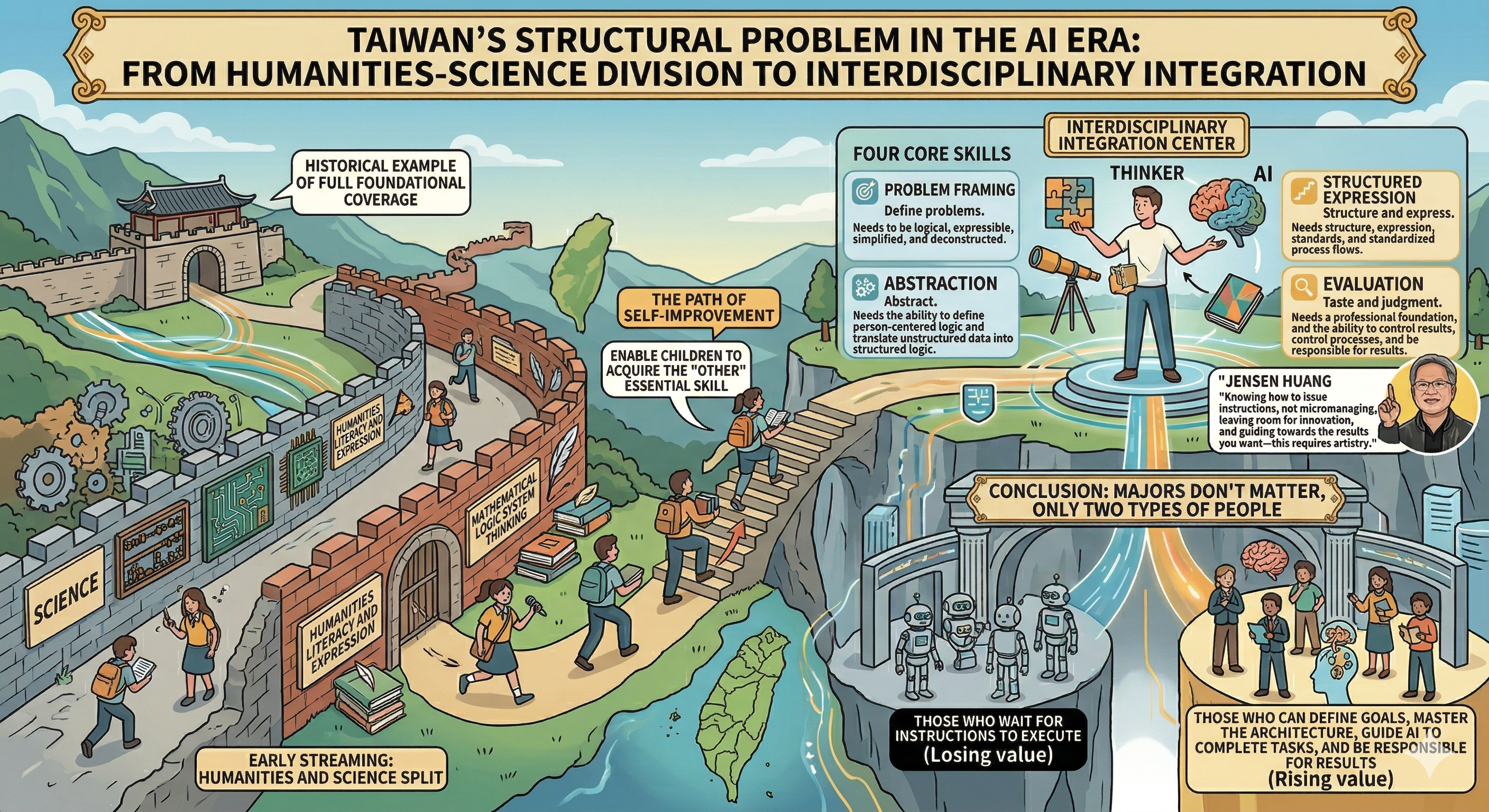
In high school, the streaming into humanities and sciences happens with a clean, early cut. For those who choose the science track, the training in humanities and linguistic expression almost stagnates; for those in the humanities track, the foundation in mathematical logic and systems thinking is paper-thin. In university, these professional barriers only deepen, and mechanisms for cross-disciplinary supplementation are virtually nonexistent.
This isn't an issue of individuals not working hard; it's that the system gives you no space to grow a "second leg."
In contrast, the old A-Level and CE (Certificate of Education) system in Hong Kong required students to maintain relatively comprehensive foundational coverage across arts, sciences, and commerce—even if you majored in science, the baseline for subjects like Chinese, English, Liberal Studies, and History wouldn't be too low. This design might not necessarily produce top-tier specialists, but it gave everyone a starting line of "not being completely blind when crossing disciplines."
And in the AI era, this is exactly the starting line needed. You don't have to be a master of every field, but you must at least be able to understand what different fields are talking about, and communicate using structured language with people (and AI) of different backgrounds. When the system hasn't helped you build this foundation, you must consciously make up for it yourself.
This is also why Jensen Huang's statement strikes a particularly sensitive nerve in the context of Taiwan. Not because liberal arts students have truly "won," but because the vast majority of people were never trained to be individuals capable of "simultaneously utilizing both humanities and sciences thinking." The ticket to the AI era is not a degree from a specific major, but the ability for cross-disciplinary integration. And the Taiwanese education system has not yet begun issuing this ticket on a massive scale.
Summary in a Sentence:
The future will not be divided by liberal arts or sciences; it will only be divided into two types of people—those waiting for instructions to execute, and those who can define goals, master abstract architectures, guide AI to complete tasks, and take responsibility for the outcome.
As Jensen Huang himself said: "Knowing how to prompt it, knowing how to under-specify it, knowing how to have it give you enough room to be innovative, while at the same time driving it toward the result that you would expect it to... that requires artistry."
This is not a victory for the liberal arts; it is the era of the thinker.