Not a Transformation, But a Contraction: Another Way to Read the AI Job Wave
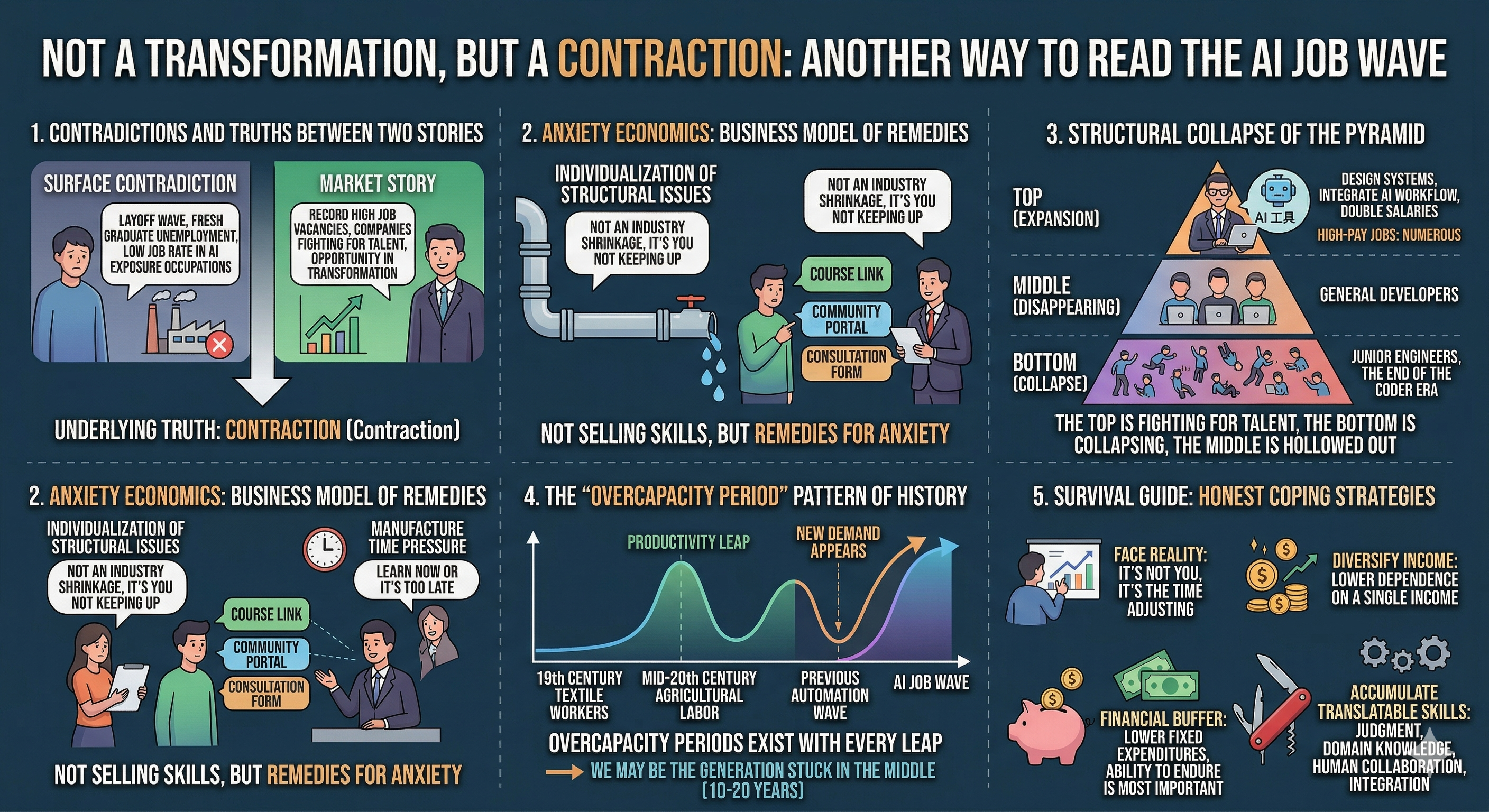 This year, there are two distinct narratives circulating in the market regarding AI and software engineering jobs.
On one side, people are talking about layoff waves, recent graduates struggling to find jobs, and a Stanford study indicating that employment for young people in highly AI-exposed professions is down by 14%. On the other side, we hear about record-high job openings, companies fighting for talent, and how "transforming" your skills will present new opportunities. When you string these two together, it’s easy to reach a convenient conclusion: "The market is weeding people out. As long as you upgrade from a 'coder' to an 'engineer', you'll be safe."
This narrative is very easy to sell. In fact, it is being sold aggressively right now.
Open Facebook, LinkedIn, or YouTube, and you'll see a whole flock of people talking in almost the exact same sentence pattern: "The coder era is over," "Engineers who know AI can double their salaries," "If you don't get on board right now, it will be too late." Their posts look similar, their conclusions look similar, and even their stock photos look similar. And usually, at the very bottom of the article, you'll find a link to a course, a portal to a community, or a consultation form.
This is not a coincidence; it's a business. And what this business is selling isn't skills, it's an antidote to anxiety.
How Anxiety is Priced
To get people to pay for a cure, you first have to make them believe they are sick. Therefore, the first step of this narrative is always to translate a structural problem into a personal one.
- It’s not "the entire industry requires fewer people," but "you are not strong enough."
- It’s not "the pyramid is narrowing," but "you are standing on the wrong side."
- It’s not "demand hasn't grown," but "you haven't kept up."
This translation step is crucial because structural problems can't be resolved by selling courses—you can't sell a course on "Fixing the Entire Industry's Supply and Demand." But personal problems can be sold, and they can be sold repeatedly. An individual can always "upgrade a little more," "learn another new tool," or "buy the next class."
The second step is to manufacture an exit that sounds reasonable. The "Coder vs. Engineer" framing is so popular not because it's the most accurate, but because it's the easiest to sell. It implies a clear path: you are here now, and if you just do A, B, and C, you will get there. It packages a future without guarantees into a train ticket you can purchase.
The third step is to create an artificial rush so you don't have time to think. All narratives of this type feature immense time pressure: if you don’t learn it now, it will be too late; the window is closing; in six months, you won't be able to catch up. Because once you have a moment to calm down and do the math, you will realize a very simple truth: if the top-tier positions are really that short of talent and the pay is really that great, why aren't these people taking those engineering jobs instead of spending their time writing Facebook posts to sell you courses?
I’m not saying everyone selling AI courses is running a scam; some are genuinely teaching valuable things. What I am saying is that when you see an entire horde of people shouting with the exact same phrases, the exact same anxiety, and the exact same cure, you should ask yourself first: Are they describing reality, or are they describing a version of reality that makes it convenient for them to do business?
What's Really Happening: Simultaneous Imbalance of Supply and Demand
After peeling off the layer of sales rhetoric, let's look back at the data.
The most direct impact AI has had on the software industry isn't "the required skills have changed," but rather "the same output now takes fewer people." Previously, a feature might have taken five engineers two months to build; now, two people plus AI can finish it in one month. This isn't science fiction; it is happening right now.
The core issue was never here. The problem is that when productivity triples, the market demand for software does not miraculously triple with it.
Corporate IT budgets haven't skyrocketed. The SaaS market was saturated ages ago. Startup funding environments have contracted. On the consumer side, no new use cases have emerged capable of absorbing all this excess capacity. Over the past fifteen years, we've already coasted off the "smartphones for everyone" dividend, and so far, AI has yet to spawn a new demand driver of equivalent magnitude.
And so, a very simple truth arises—one that most people are reluctant to talk about:
Efficiency has increased, but the newly generated capacity cannot find an outlet.
This is the true root cause of the layoff wave. It's not that engineers aren't good enough, or that workers aren't trying hard enough. It's the simple fact that the overall number of people this industry needs is decreasing.
"Shortage of Engineers" and "Layoff Waves" Are Not Actually Contradictory
Once you understand this, the seemingly contradictory phenomena are resolved.
Companies are indeed clamoring for talent, but they are fighting over a tiny group at the very top of the pyramid—those who can design complex systems, integrate AI workflows, and take direct responsibility for business results. These people were rare to begin with, and they've become even rarer now that a single person is expected to output what previously took a whole team. Accordingly, the number of open positions for them is breaking records, and their compensation will continue to rise.
But the middle and the bottom of the pyramid are vanishing. The previous structure—where a project needed one architect, three seniors, ten mid-levels, and a bunch of juniors—is being compressed down to one architect plus two or three seniors who know how to use AI. Mid-levels are becoming dispensable, and juniors are finding almost no entry points.
So, "record job openings" and "young people can't find jobs" are merely two sides of the same coin: the top is hunting aggressively for talent, the bottom is collapsing, and the middle is being hollowed out.
This is not a transformation, it is a contraction. Transformation implies that old positions disappear while new ones emerge, allowing people to migrate over. Contraction means old positions disappear, and the number of new positions is vastly smaller than the old ones, leaving the majority of people with nowhere to go.
This Isn't the First Time
If this pattern sounds familiar, it's because it truly is. The textile workers of the 19th century, the agricultural labor force in the mid-20th century, the factory line workers in the latest wave of automation—every leap in productivity is interspersed with a "period of surplus." Productivity races ahead while demand slowly catches up. And that gap in between? That's your unemployment wave.
Eventually, new demands will appear, and new forms of jobs will grow out of it. But the word "eventually" is dangerous. Because before "eventually" arrives, there are usually ten or twenty years of burden placed squarely on the shoulders of the generation caught in the middle. History books won't remember their names; they'll only remember that "the economy successfully transformed later on."
Right now, we are very likely that generation.
So, What Should We Do?
I am not going to tell you to "quickly go learn AI and upgrade yourself to an engineer." Not because learning AI is useless, but because that phrase masquerades a structural issue as a personal failing that can be solved just with hard work. If the entire industry needs fewer people, no matter how many people take classes, someone will still be squeezed out—and they won't be squeezed out because they're stupid, they’ll be squeezed out because there simply aren't enough seats.
A more honest way of putting it is this:
- Accept that the next few years will be ugly. It’s not that you aren't good enough; the era is adjusting the number of people it needs, and you just happen to be standing at the tail end of that adjustment. Think this through clearly first, so all your future decisions aren't built on a foundation of misdirected self-doubt.
- Reduce reliance on a single source of income. Not because having a "side hustle" is trendy, but because when an industry is contracting, betting all your chips on a single job carries dramatically higher risks than before. One extra income source equates to one extra layer of buffer.
- Bring down your fixed expenses. The defining characteristic of a surplus period is that income becomes unstable and unpredictable. What will keep you afloat isn't how much you earn, but how slowly you burn through it.
- Accumulate transferable, cross-domain capabilities, rather than a single technical skill. Purely technical tasks are the easiest for AI to swallow. What's genuinely hard to replace is judgment, domain knowledge, the ability to deal with people, and the capacity to stitch disparate parts into a functional system. These aren't things you can fast-track at a bootcamp, but in the long run, they are worth far more than writing a thousand lines of code.
- Re-evaluate what "work" actually means in your life. If jobs can no longer steadily provide identity, income, and meaning the way they used to, where else are you going to get those things? This is a massive question, but the sooner you start thinking about it, the better, because this isn't a transition that will resolve in a year or two.
Conclusion
Those who tell you "everything will be fine if you upgrade" usually have something to sell you. Those who tell you "the world is going to collapse" are usually selling something else. Neither side is truly describing what you are currently experiencing.
What you are experiencing is a surplus period where a technological leap is outpacing demand growth. It won't last forever, but it will last for a while, and it's not going to be a comfortable ride.
Seeing this clearly isn't an invitation to despair; it's a way to ensure your energy is spent in the right places—spent on figuring out how to survive, rather than wallowing in self-doubt, and certainly not on buying the next non-existent train ticket.