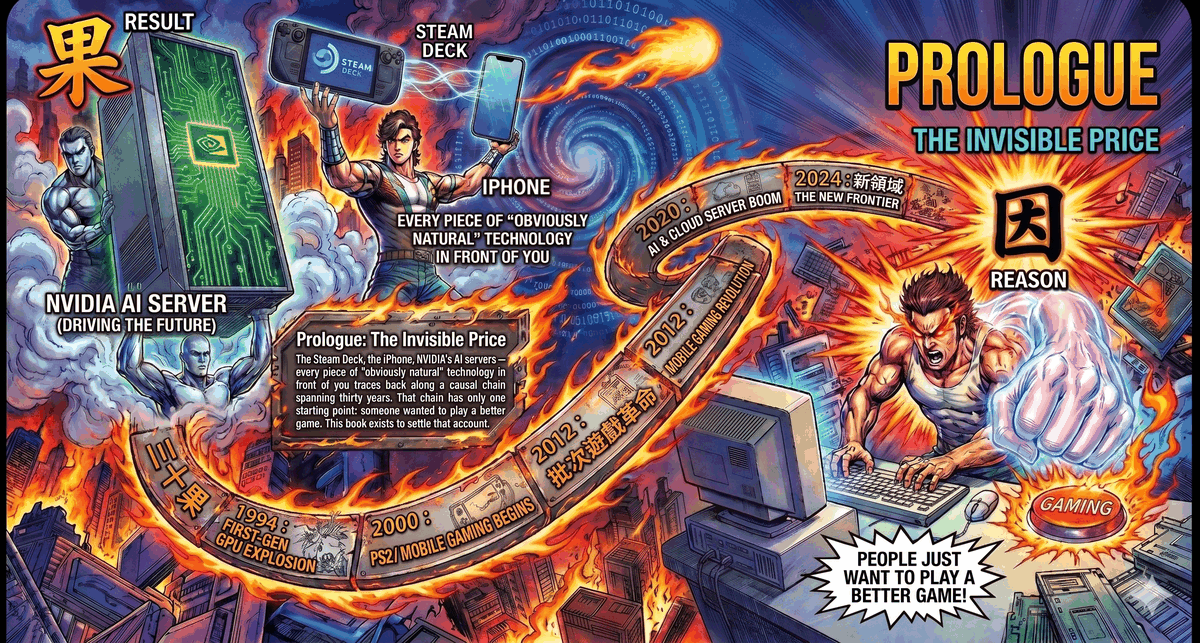
Prologue: The Invisible Cost
2:00 AM.
Perhaps the reader is turning to this page at exactly such a moment. On hand is a Steam Deck, smoothly running some latest AAA Windows game; a charging iPhone nearby lights up with a notification, then quickly goes dark. Outside the window, the city is quiet, but in a data center on the other side of the globe, an entire rack of NVIDIA servers is running day and night with the fan noise of thirty-something degrees Celsius, computing the next set of weights for an AI model. Those chips came from Hsinchu—the ultimate victory of TSMC's 3-nanometer process yield.
In this entire scene, everything seems to be taken for granted.
But none of it should exist.
The Steam Deck is a Linux handheld console; it was never supposed to run Windows games. That this can happen is because a group of people decided to gamble the fate of their company to secretly build a virtual bridge for gamers. The iPhone's processor can be mass-produced to the size of your pocket because another group of people was willing to foot the bill for larger, hotter, and more power-hungry chips—those people were PC gamers. NVIDIA was never an "AI company"; it is a company that sells gaming graphics cards. It was only by relying on an entire generation of gamers pursuing extreme graphics to share its ten years of parallel computing R&D costs that it survived until the day ChatGPT was born.
What this book is going to tell is the story behind this entire timeline.
Over the past forty years, from Silicon Valley to Hsinchu, Redmond, Tokyo, and Seoul—every major pivot in global tech hegemony has seemingly been about a CEO's gamble, Wall Street's valuation games, or a new operating system update. But if you stretch the timeline long enough, you will find that there is only one true driving force:
Someone wanted to play a better game.
This motivation sounds trivial, even a bit absurd. But it has been the most violent engine of human technological civilization over the past forty years.
In order to let them play better, companies went bankrupt, while others came back from the dead. Engineers were forced to rewrite someone else's graphics card drivers; CEOs were forced to gamble their entire company's future on something they never wanted to do in the first place. Industry standards were deliberately strangled, and technical roadmaps were overthrown at the last minute. There were dictatorial CEOs, crazy programmers, and a Japanese old man willing to swallow a five-million-dollar penalty—they had never met each other, and might not even know of each other's existence their whole lives. But every decision they made was reshaping the same invisible chassis.
This chassis is the very ground upon which the AI revolution, smartphones, the global semiconductor landscape—and even geopolitics—stand today.
It was never rationally planned.
It was forced into existence by a group of people who just wanted to play games.
This book will take you back to those scenes.
Back to a dim office in the early 1990s, watching Bill Gates personally finalize a partnership that would determine the future of the Windows empire. Back to Tokyo in the spring of 2000, watching a young Jensen Huang walk into Sega's headquarters and say a sentence that even he himself didn't believe would work. Back to a Valve conference room in the 2010s, watching a group of engineers decide that they would make Windows games run on Linux without modifying a single line of Windows source code. Back to a dust-free production line in the Hsinchu Science Park that never stops running, watching the hardest-to-manufacture chips in the world roll out one by one, never missing an appointment.
This is also a story about cost.
The cost is invisible because it is never written on financial statements. It is hidden in the yield curve of every chip, in every line of reverse-engineered graphics API, and in the fingertips of every gamer who presses "Try Again" at 3:00 AM.
Without these costs, there would be no AI today; nor would there be the iPhone in your pocket, the Steam Deck on your desk, or those GPUs on the other side of the Earth calculating the next sentence for humanity.
What this book aims to do is to recalculate this bill, clearly.